
Negotiation Training Program: Strategies for Reaching Win-Win Agreements
Negotiation is the art of achieving goals through strategic two-way communication.
Self-Paced Education · LunovonAt Lunovon, our negotiation program is designed to equip you with the tactics and fundamental principles needed in bargaining situations, both in business and personal contexts. We focus on collaborative methods that prioritize long-term solutions without compromising your core interests. Through self-paced education, you will learn how to manage conflicts of interest and turn them into productive cooperation opportunities.
- Fundamental principles of interest-based negotiation
- Mastering BATNA and ZOPA
- Persuasive communication techniques
- Concession strategies and bargaining ethics
Fundamental Principles of Interest-Based Negotiation
Many people get stuck on specific positions or numbers when negotiating. We teach you to dig deeper to find the interests underlying those positions. By understanding what the other party truly wants, you can create creative options that satisfy both sides.
This is the foundation of modern negotiation that moves away from the "win-lose" mindset toward a sustainable "win-win" paradigm. In this course, you will practice mapping hidden interests behind open demands, so that every offer you make has a logical, defensible basis.
Sticking to rigid numbers and positions, ignoring the reasons behind the opponent's demands.
Digging into core interests, then designing options that meet the needs of both parties.
Understanding BATNA and ZOPA
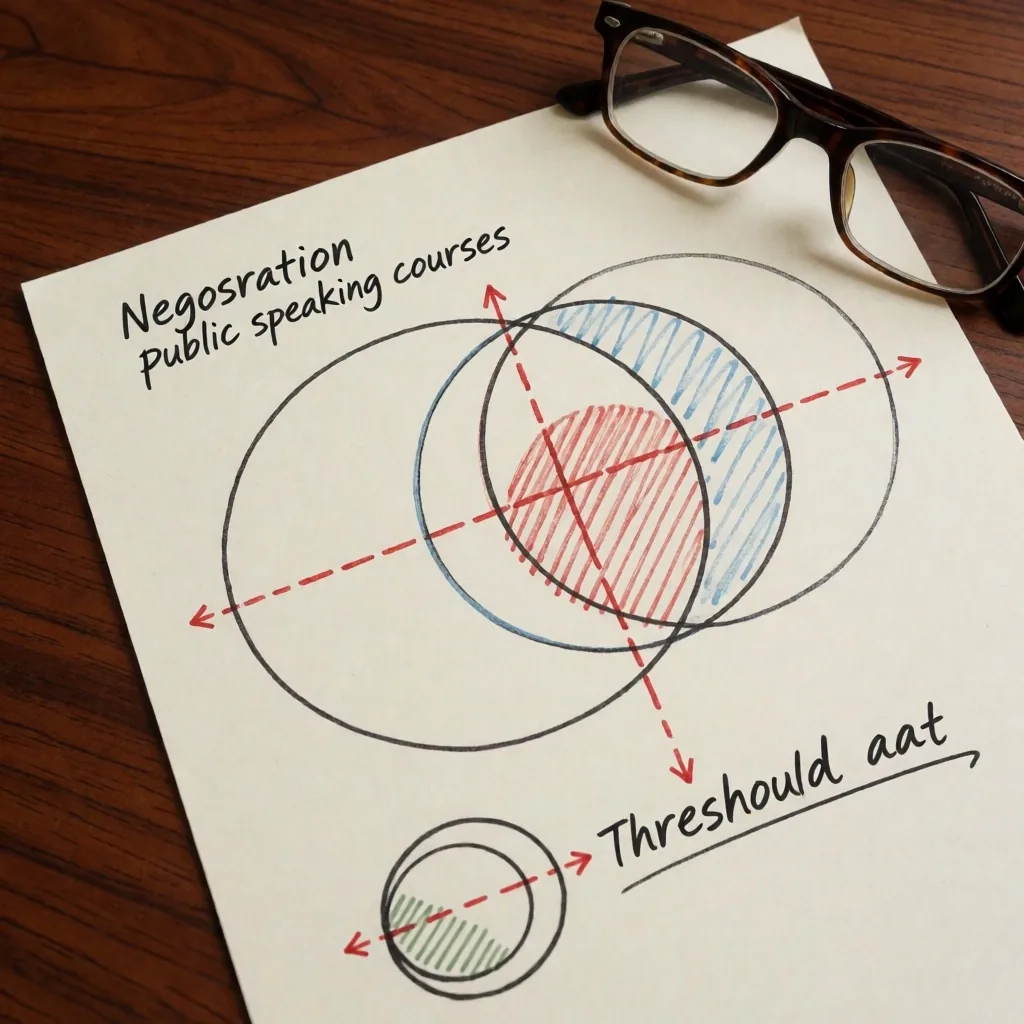
Two crucial concepts in negotiation are BATNA (Best Alternative to a Negotiated Agreement) and ZOPA (Zone of Possible Agreement). Our module explains how to calculate the threshold at which you should accept or reject an offer.
By knowing your best alternative, you will have a stronger bargaining position and will not easily get trapped in disadvantageous agreements. We provide practical guides for determining ZOPA so that the bargaining process becomes more focused.
The best alternative you have if the negotiation fails. The stronger your BATNA, the greater your courage to reject unfavorable offers. This module teaches how to identify and strengthen it before sitting at the negotiation table.
The range of agreements that might be accepted by both parties. Outside this zone, one party will refuse. You will practice mapping ZOPA based on real data, not assumptions.
The point where you must stand up and say "no". Knowing this threshold beforehand prevents decisions made under the pressure of the moment.
Persuasive Communication Techniques in Negotiation
The words you choose can determine the direction of the negotiation. We discuss framing techniques, which is how to frame an offer to make it look more attractive to the other party without changing its substance. Additionally, we teach the importance of active listening to capture hidden signals from the opposing party.
These skills help you build rapport, which is an essential element for the negotiation process to run in a conducive atmosphere. Without rapport, even the best offer can be rejected simply because the opponent feels unheard.
How to frame an offer so that the perceived value to the opponent increases without changing the actual content.
Capturing hidden signals, repeating the essence of the opponent's words, and asking open-ended questions that reveal new information.
Building trust gradually through consistency of words and actions, so that the opponent is open to compromise.

Dealing with Aggressive Negotiation Tactics
Not everyone negotiates with good intentions; sometimes you will meet parties who use intimidation or pressure tactics. This program provides a module on how to identify and counter those tactics elegantly.
You will learn how to set boundaries and when to take a break to cool down the situation. Calmness is your main weapon when dealing with difficult or highly competitive negotiation opponents.
- · Identify the type of tactics used: whether it is an open threat, a fake deadline, or emotional manipulation.
- · State boundaries calmly: explain what can be discussed and what cannot.
- · Take a strategic pause when emotions start to rise, use the time to revisit your BATNA.
- · Shift the focus from pressure to data: ask for evidence or explanations for unreasonable demands.
The Role of Emotions in Decision Making
Negotiation often involves strong emotions, such as anger or excessive excitement, which can cloud logic. We provide insights on how to manage emotional intelligence (EQ) during the negotiation process.
Understanding your own emotions and those of others allows you to stay focused on your main goals and avoid impulsive decisions that you might regret later. Emotional control is a sign of an experienced negotiator.
Every decision made in a high-emotion state tends to be suboptimal. This module teaches cognitive pause techniques: how to slow down your response by three seconds to let logic take the lead again.
Concession Strategy: Giving to Receive
In every negotiation, an exchange of value or concessions almost always occurs. We teach the principle of reciprocity, where every time you give something, you must get equivalent value in return. Do not give concessions for free without a clear reason.
This module discusses how to design a balanced offer package so that the other party feels they have achieved a win while you keep your core interests secure.
One-week payment deadline extension
Larger order volume commitment
Price discount for specific categories
Distribution territory exclusivity for one year
Illustrative example to clarify the principle of reciprocity, not a real case.
Negotiation in Professional and Business Environments

The application of negotiation techniques is broad, ranging from salary negotiations and vendor contracts to project dispute resolution. We provide case studies relevant to the working world in Indonesia to give a real picture of the challenges you might face.
By understanding power dynamics and organizational structures, you can position yourself strategically to achieve optimal results for your career or the business you run.
How to prepare market data, determine a realistic range, and convey demands with measurable foundations.
Drafting clauses that protect your interests while maintaining long-term working relationships with suppliers.
Managing conflicts between internal and external parties without damaging established professional bonds.
Drafting fair agreements for all parties involved in joint ventures or business partnerships.
Preparation Before Entering the Negotiation Table
The success of a negotiation is often determined before the meeting begins. We emphasize the importance of preparation that includes data collection, competitor analysis, and understanding the negotiation opponent's profile. Lunovon provides a preparation checklist that you can use as a guide whenever you are about to face an important negotiation.
Thorough preparation will eliminate nervousness and make you appear more competent in the eyes of the other party.
Market prices, industry standards, history of similar deals, and public information about the opposing party.
What are their hidden interests? Who is the real decision-maker? What internal pressures are they facing?
Write down the best alternative and the lowest point you can accept before negotiations begin.
Prepare at least three offer paths and anticipate the responses that might arise from each path.

Ethics and Integrity in Bargaining
Building a reputation as an honest and fair negotiator is far more valuable than a momentary victory gained through unethical means. We teach the importance of maintaining integrity and transparency in providing information.
A successful negotiation is one that is executable and does not leave resentment on the other side. Upholding ethics will open doors for long-term cooperation that is far more profitable in the future.
In practice, this means not hiding material information, not making claims that cannot be fulfilled, and not using unethical pressure just to close a deal. A damaged reputation is difficult to restore and can close access to future opportunities.
Self-Simulation Exercises and Result Evaluation
Although the material is presented digitally, we include simulation scenarios that you can practice with colleagues or friends. After conducting the simulation, you are invited to evaluate what went well and what could be improved.
This reflection process is very important in self-education to internalize the techniques that have been learned. By continuing to practice, your negotiation instincts will become sharper and your responses to various situations will become more natural.
Each simulation scenario is equipped with clear evaluation criteria: how well you identified the opponent's interests, how effective the framing techniques used were, and whether the final agreement was within the ZOPA you previously determined.
Salary negotiation, vendor contract, or project dispute — choose the one most relevant to your situation.
Ask a colleague to act as the negotiation opponent. Note key moments during the session.
Compare results with evaluation criteria. Identify successful techniques and areas that need improvement.
Change opponents, change parameters, increase complexity. Repetition is the key to instilling instinct.
Ready to hone your negotiation skills?
Study each module independently and apply it in real situations. From basic principles to practical simulations — everything is structured to help you reach a balanced agreement.
PT. Media Abbasy Ehsan
JL. IR. H. JUANDA NO. 220 D
Phone: +62 21-3005-3676
Monday–Friday, 09:00–18:00 WIB
PT. Media Suara Aceh
Jalan Banda Aceh-Medan, KM 19,5 Gampong Lam Ara Eungkit, Kecamatan Kuta Malaka, Kabupaten Aceh Besar, 23365
Telepon: +6285260952270
PT. Media Aceh Online
Jl. Syiah Kuala No.149, Lambaro Skep, Kecamatan Kuta Alam, Kota Banda Aceh, Aceh 23123
Phone: +6285222988398
Email: edaksi@acehonline.co